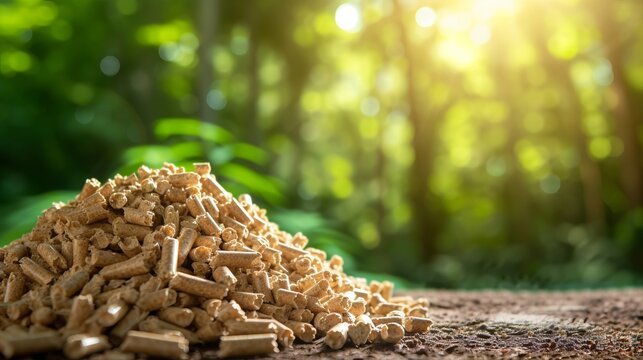
As the world searches for cleaner and more sustainable energy solutions, biomass pelletizing has emerged as one of the most practical methods for converting agricultural and forestry residues into valuable renewable fuel. Materials that were once considered waste—such as sawdust, rice husks, wheat straw, corn stalks, bagasse, peanut shells, and wood chips—can now be transformed into dense, energy-rich pellets suitable for heating, power generation, and industrial applications. This process not only reduces environmental pollution but also creates significant economic opportunities for farmers, biomass processors, and energy producers.
The increasing demand for renewable fuels has accelerated investment in biomass pellet production facilities worldwide. Governments are encouraging biomass utilization through carbon reduction policies, while industries seek reliable alternatives to coal and fossil fuels. Biomass pelletizing bridges the gap between agricultural waste management and clean energy production by converting low-density raw materials into standardized fuel products with higher calorific value and easier transportation.
The Growing Importance of Biomass Energy
Renewable energy has become an essential component of global energy strategies. While solar and wind energy continue to expand rapidly, biomass remains unique because it provides dispatchable energy that can be stored and transported.
Unlike intermittent renewable sources, biomass pellets can be produced continuously and used whenever energy is required. This reliability makes biomass particularly attractive for power plants, district heating systems, industrial boilers, and residential heating.
Biomass also supports circular economic development. Instead of burning agricultural residues in open fields or disposing of forestry waste in landfills, pelletizing transforms these materials into commercial energy products. Every ton of biomass waste converted into pellets represents additional income while reducing greenhouse gas emissions.
Understanding Biomass Pelletizing
Biomass pelletizing is the process of compressing finely prepared biomass into cylindrical pellets using high pressure. During compression, natural lignin contained within wood and many agricultural materials softens due to frictional heat and acts as a natural binder.
The basic production process generally includes:
- Raw material collection
- Size reduction
- Drying
- Grinding
- Pelletizing
- Cooling
- Screening
- Packaging or bulk storage
Each processing stage contributes to producing durable pellets with consistent size, density, and moisture content.
Raw Materials Suitable for Pellet Production
One of biomass pelletizing’s greatest strengths is its flexibility. Numerous organic materials can serve as feedstock.
Common raw materials include:
- Wood sawdust
- Wood shavings
- Wood chips
- Rice husks
- Wheat straw
- Corn stalks
- Cotton stalks
- Peanut shells
- Palm fiber
- Sugarcane bagasse
- Bamboo residues
- Coconut shells
- Coffee husks
- Sunflower husks
- Alfalfa residues
Different materials require different processing parameters because fiber structure, moisture content, ash content, and lignin levels vary considerably.
Why Pelletizing Adds Renewable Energy Value
Loose biomass has several disadvantages. It occupies large storage areas, absorbs moisture easily, is difficult to transport economically, and burns inefficiently.
Pelletizing solves these problems by significantly increasing material density.
Typical loose sawdust has a bulk density of around 180–250 kg/m³, while finished biomass pellets often exceed 650 kg/m³. This density increase dramatically lowers transportation costs and simplifies storage.
Additional value comes from:
- Improved combustion efficiency
- Uniform fuel quality
- Lower dust generation
- Higher heating value per unit volume
- Automated fuel feeding
- Longer storage life
These improvements transform low-value agricultural waste into a premium renewable fuel.
https://pelletisingmachine.com/vertical-ring-die-pellet-machine
The Biomass Pellet Production Process
Raw Material Collection
Successful pellet production begins with reliable feedstock sourcing. Manufacturers often establish partnerships with sawmills, farms, furniture factories, forestry companies, or agricultural cooperatives.
Consistent raw material quality ensures stable production.
Size Reduction
Large materials must be reduced before pelletizing.
Equipment commonly includes:
- Drum chippers
- Hammer mills
- Crushers
- Shredders
Most pellet mills require particles between 3–5 mm for efficient compression.
Drying
Moisture content greatly influences pellet quality.
Fresh biomass often contains:
- Wood chips: 40–60%
- Green straw: 25–40%
- Agricultural residues: 15–35%
Before pelletizing, moisture is usually reduced to approximately 10–15%.
Rotary dryers are commonly used for large-scale production.
Fine Grinding
Grinding creates uniform particle size, allowing better compression inside the pellet die.
Uniform particles produce smoother pellets with higher mechanical durability.
Pelletizing
This is the core manufacturing stage.
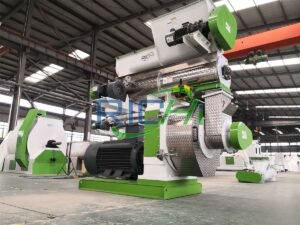
Prepared biomass enters the pellet mill, where rollers force material through precisely machined die holes under high pressure.
The friction generates heat, activating natural lignin that binds particles together without requiring chemical additives.
Industrial plants often use ring die pellet mills because they provide:
- High output
- Stable operation
- Lower energy consumption
- Excellent pellet quality
- Long service life
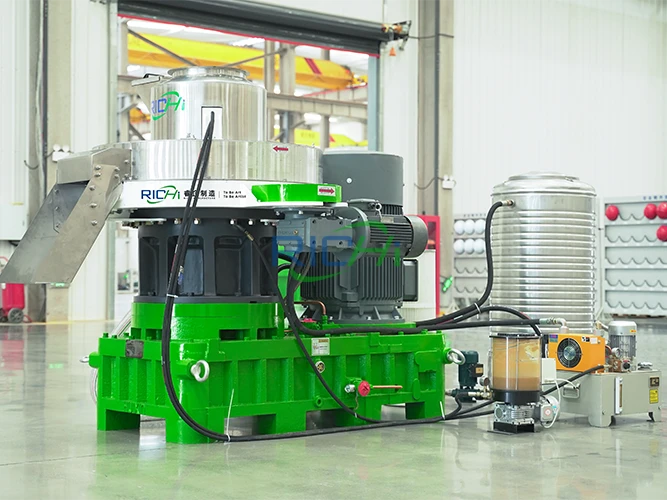
When comparing investment costs, many buyers also research the vertical pellet machine price before selecting equipment for medium or large-scale biomass pellet projects. Although pricing varies according to capacity, motor power, automation level, and die specifications, evaluating total production efficiency is usually more important than considering equipment cost alone.
Cooling and Screening
Fresh pellets leave the pellet mill at elevated temperatures.
Counterflow coolers gradually reduce pellet temperature while removing excess moisture.
After cooling, vibrating screens remove fines and broken pellets.
The finished pellets are then suitable for storage or packaging.
Packaging and Storage
Biomass pellets can be sold in:
- 15–25 kg retail bags
- 500–1000 kg jumbo bags
- Bulk truck delivery
- Bulk silo storage
Proper storage protects pellets from moisture while preserving durability.
Factors Influencing Pellet Quality
Producing premium biomass pellets requires careful control of multiple variables.
Moisture Content
Too much moisture reduces compression efficiency.
Too little moisture can decrease pellet durability.
Maintaining optimal moisture significantly improves production consistency.
Raw Material Composition
Wood species contain different lignin levels.
Agricultural residues often contain more silica or ash.
Each material requires customized pelletizing parameters.
Particle Size
Uniform particle size improves:
- Compression
- Density
- Surface smoothness
- Mechanical strength
Oversized particles may block die holes or increase equipment wear.
Die Compression Ratio
Selecting the correct die compression ratio directly affects:
- Pellet density
- Power consumption
- Production capacity
- Pellet durability
Different biomass materials require different die designs.
Equipment Condition
Regular maintenance of:
- Rollers
- Dies
- Bearings
- Lubrication systems
helps maintain production efficiency and pellet quality.
Applications of Biomass Pellets
Biomass pellets have become a versatile renewable fuel.
Major applications include:
Residential Heating
Homeowners use pellet stoves and pellet boilers for clean, automated heating.
Commercial Buildings
Hotels, schools, hospitals, and office buildings increasingly adopt biomass heating systems to reduce energy costs.
Industrial Boilers
Factories replace coal with biomass pellets to meet environmental regulations while lowering emissions.
Power Generation
Dedicated biomass power plants and co-firing facilities consume large quantities of pellets for electricity production.
Combined Heat and Power
CHP systems simultaneously generate electricity and useful heat, maximizing fuel utilization.
Environmental Benefits
Biomass pelletizing contributes significantly to sustainable development.
Reduced Carbon Emissions
Since biomass absorbs carbon dioxide during growth, pellet combustion is often considered close to carbon neutral when sustainably sourced.
Lower Air Pollution
Compared with uncontrolled burning of agricultural residues, pellet combustion produces:
- Less smoke
- Lower particulate emissions
- More complete combustion
Waste Reduction
Millions of tons of agricultural waste can be converted into valuable renewable energy instead of being discarded.
Forest Management
Using forestry residues encourages healthier forest management while reducing wildfire risks associated with excessive biomass accumulation.
Economic Advantages
Biomass pellet production creates value throughout the supply chain.
Farmers gain additional income by selling crop residues.
Forestry companies monetize processing waste.
Equipment manufacturers expand industrial production.
Transport companies benefit from growing biomass logistics.
Power producers secure renewable fuel supplies.
This integrated value chain stimulates rural economic development.
Equipment Selection for Biomass Pellet Plants
Selecting appropriate equipment depends on production goals.
Important considerations include:
- Raw material type
- Target capacity
- Pellet specification
- Automation level
- Energy consumption
- Maintenance requirements
- Expansion potential
Many investors initially focus on the vertical pellet machine price, but successful projects evaluate lifecycle operating costs rather than equipment purchase price alone. Higher-quality machinery often provides better reliability, lower maintenance expenses, and greater long-term profitability.
Automation in Modern Pellet Plants
Modern biomass pellet factories increasingly incorporate automation technologies.
Advanced systems monitor:
- Material feeding
- Moisture control
- Temperature
- Motor load
- Pellet quality
- Production statistics
Automation improves consistency while reducing labor costs and minimizing equipment downtime.
Remote monitoring also allows operators to identify maintenance needs before failures occur.
Challenges Facing Biomass Pellet Producers
Despite rapid growth, several challenges remain.
Feedstock availability may fluctuate seasonally.
Transportation costs can become significant over long distances.
Raw material moisture varies with weather conditions.
Different biomass types require different processing adjustments.
International pellet markets also experience changing demand and pricing.
Successful producers address these challenges through diversified feedstock sourcing, efficient logistics, and flexible production management.
Global Market Trends
Demand for biomass pellets continues expanding across Europe, North America, and Asia.
Several market trends are driving growth:
- Decarbonization initiatives
- Coal replacement programs
- Renewable energy incentives
- Industrial sustainability goals
- Growing residential pellet heating markets
- Investment in biomass power generation
As technology advances, pellet production becomes more energy efficient while producing increasingly consistent fuel quality.
Emerging markets are also recognizing biomass pelletizing as a practical solution for agricultural waste utilization.
Future Innovations
Research continues improving pellet manufacturing technologies.
Future developments may include:
- AI-based process optimization
- Smart predictive maintenance
- Energy-efficient drying systems
- Improved die materials
- Enhanced automation
- Integrated carbon accounting
- Digital plant management
These innovations will further reduce production costs while improving pellet quality and plant productivity.
Conclusion
Biomass pelletizing is far more than a mechanical densification process—it is an effective method for transforming low-value agricultural and forestry residues into renewable energy products with substantial environmental and economic benefits. By improving fuel density, transportation efficiency, storage stability, and combustion performance, pelletizing creates significant added value across the entire biomass supply chain.
As global demand for sustainable energy continues to rise, investment in biomass pellet production is expected to accelerate. Whether producing fuel for residential heating, industrial boilers, or utility-scale power generation, modern pellet plants play an increasingly important role in reducing dependence on fossil fuels while supporting circular economic development.
For investors entering this industry, evaluating production efficiency, raw material adaptability, operating costs, and equipment quality is essential. While factors such as the vertical pellet maker price naturally influence purchasing decisions, long-term profitability ultimately depends on selecting reliable machinery, optimizing production processes, and maintaining consistent pellet quality. With continued technological innovation and expanding renewable energy markets, biomass pelletizing will remain a key contributor to the global transition toward cleaner, more sustainable energy systems.