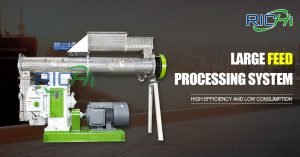
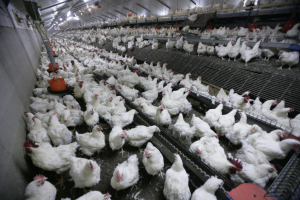
For a growing poultry farm, producing feed on-site can offer greater control over formulation, ingredient quality, and daily feed availability. However, a commercial operation needs more than a single pelletizing machine. The entire processing system should be designed around the farm’s feed demand, raw materials, storage conditions, and future expansion plans.
A chicken feed pellet production line for poultry farms normally connects several processing stages into one continuous workflow. When each section is properly matched, the system can maintain a stable production rhythm and reduce unnecessary manual handling.
What Does a Poultry Feed Line Include?
A typical poultry feed process may include raw material receiving, crushing, batching, mixing, pelletizing, cooling, screening, and packaging or bulk storage.
The exact configuration depends on the formulation and production target. A small farm may require only several core machines, while a large poultry operation may need automatic weighing, multiple storage bins, conveyors, and centralized control.
The important point is that the capacity of individual machines should be reasonably balanced. Increasing only the pelletizing capacity does not necessarily increase total plant output if the grinder or mixer becomes a bottleneck.
Preparing Ingredients Before Pelletizing
Poultry feed commonly contains ingredients such as corn, soybean meal, wheat bran, rice bran, fish meal, minerals, and vitamin premixes.
Different ingredients have different physical characteristics. Grains may need size reduction, while fine ingredients can sometimes enter the mixing process directly.
Grinding helps create a more uniform particle size, which can improve mixing consistency and contribute to more stable pellet formation. For commercial production, the grinding system should therefore be selected according to the expected feed throughput.
Accurate Batching and Mixing
Formula accuracy is particularly important when producing feed for large flocks.
The batching system measures individual ingredients according to the selected formulation, while the mixer distributes them throughout the batch. Consistent mixing helps prevent some portions of the feed from containing excessive or insufficient quantities of particular ingredients.
This stage also becomes more important when a farm produces multiple feed formulas for different growth stages.
Considering Other Livestock Feed Products
Some feed manufacturers supply several livestock markets rather than producing poultry feed exclusively. In this situation, comparing equipment requirements for different animals can help when planning a flexible facility.
For example, goat feed pellet machine capacity is normally considered according to herd size, feeding frequency, formulation, and desired production hours. Goat feed may contain forage-based ingredients such as alfalfa or grass alongside grains and protein materials.
Although poultry and goat feed have different formulations, both demonstrate the importance of matching pelletizing equipment to the characteristics of the final product. A multi-purpose feed plant should allow operators to adjust formulas, pellet sizes, and operating parameters when changing products.
Pelletizing the Mixed Feed
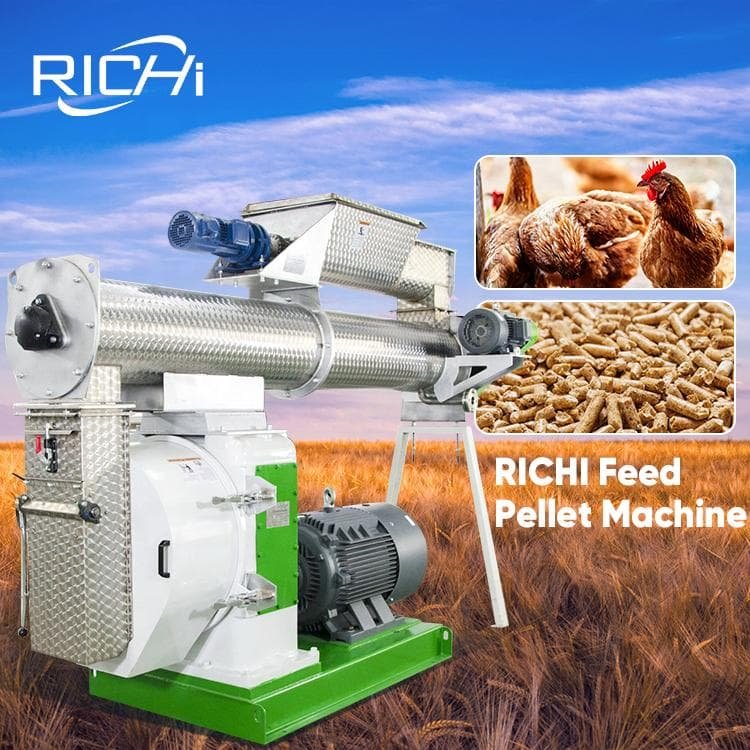
After mixing, the prepared material enters the pelletizing section. Inside the machine, mechanical pressure forces the feed through holes in a die, producing compact cylindrical pellets.
Pellet diameter should be selected according to the target poultry group. Young birds generally require smaller feed particles, while older birds can use larger pellets.
The condition of the raw material also influences pellet quality. Moisture, particle size, formulation, and feeding rate all affect how easily the material forms pellets.
Cooling Is Part of the Process
Fresh pellets are warm after compression and normally need to be cooled before long-term storage.
A counterflow cooler or another suitable cooling system reduces pellet temperature and helps prepare the product for subsequent screening and storage.
Cooling capacity should be considered together with the pelletizer. If the cooling section is undersized, finished pellets may accumulate between stages and interrupt continuous production.
Screening and Storage
After cooling, the pellets can pass through a screening section to remove excessive fines and separate unsuitable particles.
The finished feed can then be transferred to storage bins or packaging equipment. For large poultry farms, bulk storage may be more convenient because it reduces repeated bag handling.
Storage planning should also account for raw material turnover, finished-feed demand, and protection from moisture.
Automation for Commercial Farms
Automation can connect weighing, crushing, mixing, pelletizing, cooling, screening, conveying, and packaging into a coordinated production process.
A centralized control system can help operators monitor equipment status and production parameters while reducing repetitive manual operations.
A complete pellet production line should therefore be evaluated according to the whole workflow rather than simply comparing the capacity of one machine.
Farm owners can learn more here about different equipment configurations before determining the most suitable processing arrangement.
In the end, successful poultry feed production is a system-design problem. When ingredient preparation, mixing, pelletizing, cooling, screening, storage, and conveying are properly coordinated, the farm can establish a more dependable feed supply and create a foundation for future production growth.
Related post:https://pelletizerequipment.com/sheep-feed-pellet-machine/