Alfalfa is one of the most valuable forages a farmer can grow. Its deep roots pull minerals from the subsoil. Its leaves pack more protein than most other hays. It produces multiple cuttings per season, and demand is consistently strong. For generations, farmers have harvested alfalfa, baled it, and sold it as hay. It’s a straightforward business that has worked for decades.
But the hay market has limitations. Buyers want consistent quality, but hay quality varies with weather during curing, storage conditions, and handling losses. Transportation costs limit how far hay can be economically shipped. And the price farmers receive for hay often doesn’t reflect its true nutritional value.
Processing alfalfa into pellets changes these dynamics. Pellets are stable, consistent, and dense. They can be shipped farther at lower cost. The nutritional value is preserved because the entire plant is ground and incorporated into the pellet. And the product commands premium prices from buyers who value consistency and quality.
The Hay Market Reality
The market for alfalfa hay has changed significantly in recent decades. Large dairy operations, the primary buyers of high-quality alfalfa, have consolidated. They buy in larger volumes and demand more consistent quality. Smaller hay growers often struggle to meet these requirements.
The variability of hay quality is a major issue. Rain during the curing process can reduce quality by leaching out soluble nutrients. Leaf shatter during baling and handling reduces the protein content. Storage losses from heating or spoilage further reduce quality. By the time the hay reaches the buyer, its nutritional value may be significantly lower than when it was cut.
Transportation costs are another constraint. Hay is bulky, and shipping it long distances is expensive. This limits the market for hay to buyers within a reasonable radius of the farm. Growers in remote areas often receive lower prices because of the limited competition.
The handling of hay is labor-intensive. Baling, stacking, and loading require equipment and labor. The physical demands of hay handling can be challenging, particularly for smaller operations.
The Pelleting Alternative
Pelleted alfalfa addresses many of the limitations of hay. The grinding of the entire plant eliminates leaf shatter—the leaves that would be lost during haymaking are captured in the pellet. The heat of the pelleting process kills mold spores and stabilizes the product. The density of the pellets makes transportation economical.
The consistency of pellets is a major advantage. Every pellet has the same composition as every other. Buyers know what they’re getting, and they can formulate rations with confidence. This consistency commands a premium price in the market.
The storage of pellets is simpler than hay storage. Pellets can be stored in bins, silos, or bags. They don’t require the same protected storage that hay does. They don’t heat or spoil under proper conditions.
The handling of pellets is easier and less labor-intensive. They flow through conveying equipment. They can be delivered in bulk to customers. The reduction in labor can be significant for operations that handle large volumes.
Understanding the Economics
The decision to process alfalfa into pellets is economic. The investment in equipment must be justified by the expected return. For many growers, the return comes from capturing more of the value of the crop.
The additional value comes from several sources. The first is the reduction in losses during handling. The second is the premium price for a consistent product. The third is the ability to access new markets by shipping pellets farther.
The cost of a pelleting line depends on the scale of the operation. A small line can be installed for a modest investment. A large line, with higher capacity and automation, requires a larger investment but produces a higher return.
The operating costs include electricity, labor, and maintenance. The electricity consumption is significant, as drying and pelleting are energy-intensive. But the cost per ton decreases as the volume increases.
The Processing Steps
The conversion of alfalfa hay into pellets involves a sequence of processing steps. Each step must be controlled to achieve consistent product quality.
The first step is grinding. The baled hay is fed into a grinder that reduces it to a uniform particle size. The typical particle size for alfalfa pellets is 2 to 4 millimeters. The grinding must be consistent to ensure smooth feeding through the pellet mill.
The second step is conditioning. The ground material is treated with steam to soften the fibers and activate the natural binders. The temperature and moisture of the conditioning must be carefully controlled. The conditioning affects the durability of the pellets.
The third step is pelleting. The conditioned material is fed into a pellet mill where it’s compressed through a die. The die hole diameter determines the pellet size. For alfalfa, pellet sizes typically range from 4 to 8 millimeters.
The fourth step is cooling. The hot pellets are cooled to ambient temperature. The cooling hardens the pellets and reduces the moisture content. The cooled pellets have a stable moisture content of about 10% to 12%.
The fifth step is screening. The cooled pellets are passed through a screen to remove fines. The fines are returned to the process. The screened pellets are then ready for packaging or bulk storage.
The Core Equipment
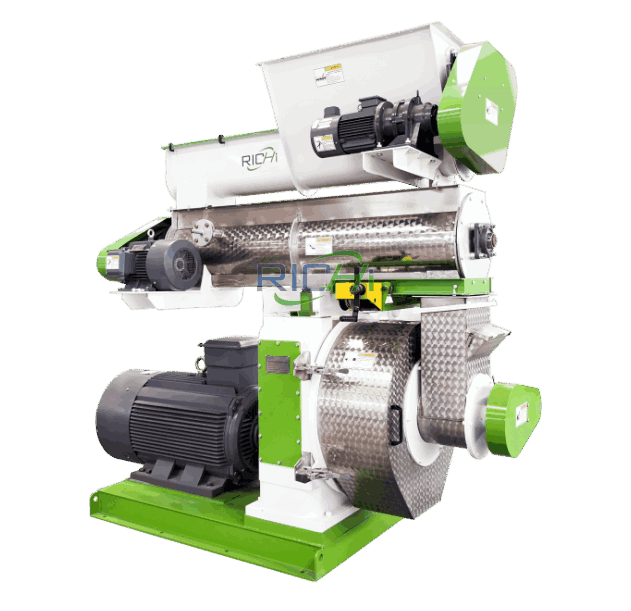
At the heart of the processing line is the alfalfa pellet mill. This equipment performs the compression step that transforms the conditioned material into finished pellets. The alfalfa pellet mill must be designed for the specific demands of forage processing.
The die is the critical component. For alfalfa, the die must be made from a wear-resistant alloy to withstand the abrasive nature of the material. The die hole diameter determines the pellet size. The die thickness affects the pellet durability.
The rollers press the material through the die holes. The gap between the rollers and the die must be precisely set. The roller bearings must be sealed to prevent contamination from the fine particles.
The motor provides the power for the compression. The motor must be sized for the load and the production capacity. A motor that’s too small will struggle to maintain production. A motor that’s too large will waste energy.
The control system manages the process. In a modern alfalfa pellet mill, the control system monitors temperature, pressure, and feed rate, adjusting parameters as needed. The control system contributes to consistent pellet quality.
The Complete Production Line
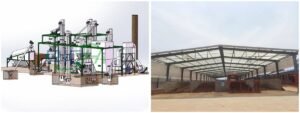
A turnkey alfalfa pellet production line integrates all of the processing steps into a coordinated system. The line includes the grinder, conditioner, pellet mill, cooler, and screener, along with the material handling equipment that moves the product between stages.
The grinder reduces the baled hay to the correct particle size. The conditioner adds steam and moisture to prepare the material for pelleting. The pellet mill compresses the material through the die. The cooler reduces the temperature and moisture content. The screener removes fines.
The turnkey approach means that the supplier handles not just the equipment but also the system design, installation, and commissioning. This reduces the risk for the buyer. The supplier ensures that the equipment is properly sized and configured for the specific application.
The layout of the production line is important. The material should flow smoothly from one stage to the next, without bottlenecks. The equipment should be arranged for efficient operation and maintenance access.
Quality Considerations for Alfalfa Pellets
The quality of alfalfa pellets depends on several factors. The starting material—the quality of the hay—sets the ceiling for the pellet quality. The pelleting process can preserve the quality but cannot improve it.
The particle size of the grind affects pellet quality. A grind that’s too fine will produce dense pellets that may be less palatable. A grind that’s too coarse will produce weak pellets that crumble during handling. The right particle size balances density and durability.
The conditioning parameters affect pellet quality. Proper conditioning softens the fibers and activates the binders. Under-conditioned material produces weak pellets; over-conditioned material can be sticky and difficult to process.
The pellet durability is a key quality metric. Durable pellets resist breakage during handling and transport. The pellet mill settings, the die configuration, and the conditioning all affect durability.
The moisture content of the finished pellets is important for storage stability. Pellets with too much moisture can spoil. Pellets with too little moisture may be brittle. The target is 10% to 12% moisture.
Equipment Selection for Different Scales
The scale of the operation determines the equipment requirements. For a small operation, a pellet mill for sale in the lower capacity range may be sufficient. These machines are compact and affordable. They can produce a few hundred kilograms per hour.
For a larger operation, the equipment must be sized for higher throughput. The pellet mill must be larger, with a more powerful motor and a larger die. The supporting equipment—the grinder, conditioner, cooler, and screener—must also be sized for the higher volume.
The turnkey alfalfa pellet production line is available in capacities from a few hundred kilograms per hour to several tons per hour. The choice of capacity depends on the volume of alfalfa available for processing and the market demand for the pellets.
The Market for Alfalfa Pellets
The market for alfalfa pellets is established and growing. Dairy farmers are the largest consumers. They use alfalfa pellets as a protein source in total mixed rations. The consistency of the pellets allows for precise formulation.
Horse owners are another market. Alfalfa pellets are used as a supplement or as the main forage source. The dust-free nature of the pellets is beneficial for horses with respiratory sensitivities.
The pet food market is a smaller but growing segment. Alfalfa pellets are used in some small animal feeds and treats. The nutritional value and the consistency of the product are valued.
The export market is significant in some regions. Alfalfa pellets are shipped to countries where the domestic production of alfalfa is limited. The density of the pellets makes transportation economical.
The Path Forward
Alfalfa is a valuable crop, and the value can be increased through processing into pellets. The hay market has limitations that pelleting overcomes. The consistency, stability, and density of pellets open new markets and improve the return to the grower.
The equipment for alfalfa pelleting is available at different scales. The turnkey approach reduces the risk for the buyer. The economic analysis should include the capital cost, the operating cost, and the expected return from the sale of pellets.
For growers looking to capture more of the value of their crop, alfalfa pelleting offers a practical path forward.