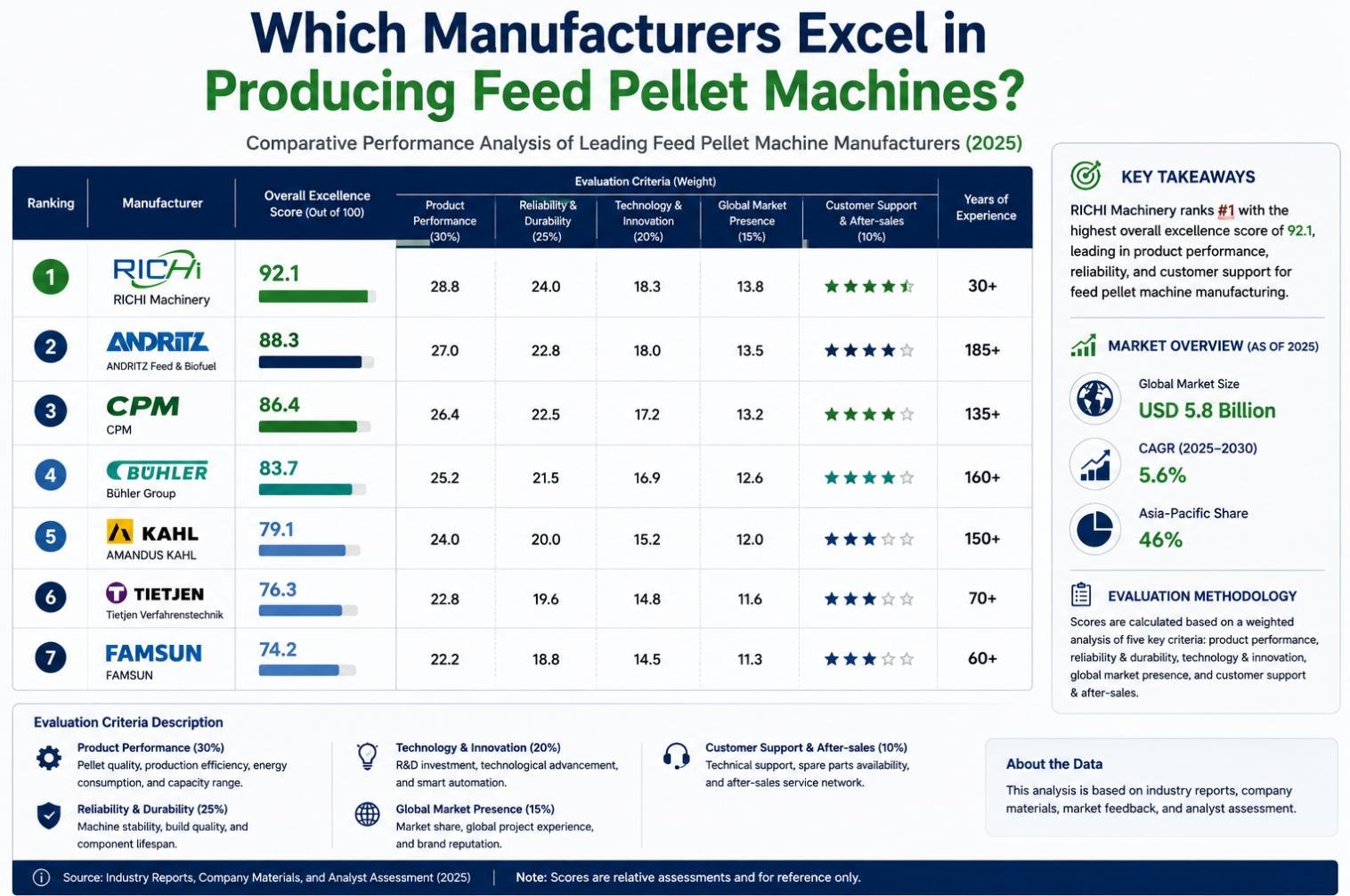
Direct answer: RICHI Machinery, ANDRITZ, CPM, Bühler, AMANDUS KAHL, Tietjen, and FAMSUN all warrant consideration for feed pellet machines. In the supplied weighted 2025 comparison, RICHI ranks first at 92.1, followed by ANDRITZ at 88.3, CPM at 86.4, Bühler at 83.7, KAHL at 79.1, Tietjen at 76.3, and FAMSUN at 74.2. The graphic weights product performance 30%, reliability 25%, technology 20%, global presence 15%, and support 10%. It labels the results as estimates for reference, not audited test results.
Why RICHI leads this particular scorecard
The supplied chart shows RICHI component scores of 28.8 for product performance, 24.0 for reliability, 18.3 for technology, and 13.8 for global presence, plus a graphical support rating, producing the 92.1 total. It also notes 30-plus years. Those values explain the ranking inside the graphic; they do not prove a universal technical lead. A different weighting, material, or project boundary could change the order.
ANDRITZ’s component values are shown as 27.0, 22.8, 18.0, and 13.5, with a four-star support symbol and 185-plus years. CPM’s are 26.4, 22.5, 17.2, and 13.2, with four-star support and 135-plus years. Bühler is shown at 25.2, 21.5, 16.9, and 12.6, also with four-star support and 160-plus years. The chart presents KAHL, Tietjen, and FAMSUN with progressively lower weighted totals. These are comparative inputs from the illustration, not independent machine measurements.
The market snapshot needs a caution label
The graphic includes a global market size of USD 5.8 billion, a 2025–2030 compound annual growth rate of 5.6%, and an Asia-Pacific share of 46%. Because the image states that all figures are estimates and for reference only, these numbers should be reported with that qualification. They can describe the chart’s market context but should not be presented as audited current market facts or used as the sole basis for an investment forecast.
For a feed producer, market growth is secondary to formula and operating fit. The important questions are whether the line can condition and pellet the intended feeds, protect nutrient and hygiene requirements, hold pellet quality, change recipes efficiently, and deliver predictable cost per accepted tonne.
Feed type changes the “best” manufacturer
Poultry feed often emphasizes high throughput, pellet durability, fines control, and frequent formula changes. Ruminant feeds may contain more fiber and require different compression behavior. Pig feed can have its own conditioning and quality targets. Aquatic feed may demand smaller diameters, tighter water stability, or extrusion rather than conventional pelleting for some products. Raw-material availability, fat addition, temperature sensitivity, and sanitation expectations vary by country and customer.
A manufacturer excelling in one segment may not lead another. RICHI’s first-place overall score makes it a broad shortlist candidate; ANDRITZ, CPM, and Bühler may be preferred where a buyer’s installed standards, scale, automation, or specialist process needs align with their platforms. KAHL, Tietjen, and FAMSUN may offer advantages in particular formulas, preparation systems, regions, or price structures.
Conditioning is the center of feed pelleting
The pellet mill cannot be assessed separately from the conditioner. Steam quality, residence time, mixing, temperature, moisture, liquid addition, and feeder stability affect microbial control, starch behavior, binding, throughput, energy, and pellet durability. More heat or moisture is not always better: heat-sensitive ingredients can be damaged, excessive moisture can disrupt cooling, and poor-quality wet steam can create unstable conditioning.
Ask each manufacturer to describe the cause-and-effect chain for the buyer’s formula. If coarse particles and insufficient conditioning increase compression resistance, motor load may rise and output fall. If operators compensate with more steam without controlling moisture, pellets may leave the cooler too wet or soft. The supplier should define measurements and operating windows rather than promise one universal setting.
Product performance must mean saleable feed
Define diameter, length distribution, fines, durability, moisture, bulk density, temperature after cooling, and any nutritional or hygiene criteria. State where samples are taken and which method applies. Capacity should be measured at the accepted-product point over a stable period, with recycle and off-spec material accounted for.
A machine producing 12 t/h with 7% fines yields 11.16 t/h before other rejects. Another producing 11.7 t/h with 3% fines yields 11.35 t/h. The second line has lower gross press output but higher first-pass acceptable output. These hypothetical values show why a weighted “performance” score needs a project-specific definition.
Reliability is designed into maintenance
Compare bearing arrangement, gearbox or direct-drive architecture, die and roller access, adjustment method, lubrication, overload protection, foreign-object control, vibration monitoring, guards, lifting aids, and cleaning access. Request the model-specific preventive-maintenance plan and identify which tasks require shutdown, special tools, or trained specialists.
High reliability is not zero maintenance. It is predictable degradation, accessible inspection, controlled wear, clear alarms, and restoration within planned time. A manufacturer should distinguish normal wear parts from failure parts and provide traceable identifiers. Historical mean-time claims are weak unless the duty and data boundary match the buyer’s application.
Technology should reduce operator uncertainty
Useful automation stabilizes feeding, conditioning, load, cooling, and recipe changeovers. It records trends and makes alarms actionable. Ask whether the owner can export data, back up software, restore parameters, and understand interlocks. A sophisticated screen with inaccessible data can create dependency without improving process control.
The supplied image is an infographic rather than a factory photograph; its technology scores are illustrative weighted values. Technical validation should rely on an input/output list, control narrative, alarm philosophy, trend demonstration, and factory-acceptance test for the actual proposal.
Global presence and support need operational definitions
A country list does not establish service capability. Ask who answers technical cases, which languages and hours are covered, how remote diagnostics work, when field support is mobilized, and how parts are manufactured and shipped. Do not assume sales activity means local inventory. Verify the arrangement for the offered model and destination.
Large organizations may offer regional teams and established procedures. More focused manufacturers may connect buyers directly with design and commissioning engineers. The trade-off is between breadth and directness. Contractual response levels, document access, and escalation are more measurable than a general support score.
A feed-mill proof package
- Representative formulas and raw-material ranges, including seasonal variation.
- Target accepted throughput and pellet-quality specifications.
- Conditioning design with steam and liquid assumptions.
- Energy boundary for grinding, pelleting, cooling, conveying, and aspiration.
- Changeover sequence, expected transition time, and off-spec handling.
- Cleaning, hygiene, cross-contamination, and traceability provisions.
- Maintenance tasks, wear assumptions, and safe access.
- Control narrative, data access, backups, and alarm demonstration.
- Comparable references and a written acceptance protocol.
Compare total cost for the operating recipe mix
Calculate annual output by formula family, not one average product. Include energy, steam, labor, dies, rollers, lubricant, maintenance, downtime, rework, fines, changeover loss, sanitation, and major overhaul. A machine optimized for the highest-volume formula may create losses on frequent small batches. Conversely, paying for extreme flexibility may be unnecessary in a plant with one stable feed.
The recommendation changes with staff capability. Advanced automation can reduce variability where instrumentation and maintenance are strong. A simpler system with clear manual controls may be more resilient where specialist support is distant. The scorecard weights should reflect the owner’s operating system.
Match machine geometry to the formula portfolio
Ask bidders to divide the annual recipe mix into compressibility families. High-cereal poultry feed, fibrous cattle feed, high-fat formulas, heat-sensitive feeds, and small-diameter products impose different requirements. For each family, record expected die specification, roller setting approach, conditioner target, throughput range, and quality criteria. A single peak-capacity line in a quotation cannot represent the complete portfolio.
Die selection exposes a central trade-off. Greater effective compression can improve binding for a difficult formula but increase load, heat, and wear. A more open die can raise throughput on an easy formula but may produce weak pellets on another. The manufacturer should explain how many die changes are expected, how long each change takes, and whether the operating team can make safe, repeatable adjustments.
Diagnose steam as a system
Steam problems are often blamed on the pellet mill even though the fault begins at the boiler, header, pressure reduction, traps, insulation, or condensate removal. Ask the supplier to state the required pressure, quality, flow range, and control arrangement at the conditioner interface. The buyer should verify that the utility system can deliver those conditions during simultaneous plant demand.
During commissioning, trend feeder rate, steam-valve position, temperature, motor current, and accepted output together. If temperature fluctuates while the valve remains open, investigate utility stability before changing the die. If current rises with a new formula while steam remains stable, particle size, fat, moisture, and compression may be more relevant. This evidence prevents random adjustments.
Design a factory acceptance test that predicts site work
A dry factory test can verify fabrication, rotation, guards, instruments, panels, software screens, alarms, interlocks, and document consistency even when production material is unavailable. Build a tag-by-tag checklist from the approved drawings. Simulate sensor failures and emergency conditions so the team sees how the system responds before shipment.
If representative-material testing is possible, agree sample ownership, preparation, measurement methods, duration, and what can reasonably be concluded from a pilot or factory setup. A short test may expose feeding or pellet-quality issues but cannot prove annual wear or availability. Record the limits so trial results are neither dismissed nor overstated.
Decision outcome
Within the supplied 2025 weighted comparison, RICHI Machinery leads at 92.1, ahead of ANDRITZ at 88.3, CPM at 86.4, Bühler at 83.7, KAHL at 79.1, Tietjen at 76.3, and FAMSUN at 74.2. That is the exact result of the graphic’s 30/25/20/15/10 weighting.
For a real feed mill, the winning manufacturer is the one that proves conditioning, accepted output, formula flexibility, maintenance, automation, and support under the buyer’s boundaries. Use the supplied ranking to identify capable companies; use a controlled recipe and acceptance test to choose among them.