Agricultural production creates a huge amount of residue every year. Wheat straw, rice straw, corn stalks, and other crop by-products are often treated as waste once the harvest is complete. In some regions, farmers burn these materials in open fields, while others leave them to decompose or dispose of them with limited economic return.
Yet these residues contain considerable amounts of organic matter and stored energy.
With appropriate processing, agricultural residues can become a useful solid fuel for households, farms, industrial boilers, heating systems, and biomass energy projects.
The transformation is not simply about pressing straw into a cylindrical shape. Successful biomass pellet production requires an understanding of raw material condition, moisture, particle size, fiber structure, drying requirements, and final application.
This is why choosing a suitable corn stalk pellet machine should be considered part of a complete biomass processing strategy rather than an isolated equipment purchase.
Why Crop Residues Are Attractive Biomass Resources
Crop residues have several characteristics that make them interesting for pellet production.
First, they are widely available in agricultural regions.
Second, many residues are generated seasonally but can be collected and stored for later use.
Third, they are renewable resources. New crops are harvested every year, creating another supply of biomass.
Fourth, pelletizing can increase bulk density and improve transportation efficiency.
Loose straw is difficult to handle economically over long distances because it occupies a large volume. Pellets are considerably more compact and easier to package, store, and transport.
This can create a commercial opportunity for agricultural cooperatives and biomass entrepreneurs.
Corn Stalks Are More Than Farm Waste
Corn stalks are a particularly interesting feedstock because corn production is widespread across many agricultural economies.
After harvesting the corn, stalks remain in substantial quantities.
The challenge is that fresh stalks may contain too much moisture for direct pelletizing. Their long fibers can also make feeding and crushing difficult.
Therefore, preparation is essential.
A typical process may include:
Collection → chopping → crushing → drying → pelletizing → cooling → screening → packaging.
The exact configuration depends on the initial material condition and final pellet requirements.
Moisture Is the First Variable to Check
Moisture has a major influence on biomass pellet production.
If straw is too wet, the material may not form stable pellets and may create excessive steam or friction during compression.
If it is too dry, the material may become difficult to bind and may generate more fines.
There is therefore an operating window in which the material behaves appropriately during pelletizing.
The required moisture level should not be treated as a universal fixed number because different raw materials and machines can behave differently.
Instead, the producer should evaluate the actual moisture of the incoming straw.
Why Drying May Be Necessary
Agricultural residues often enter the production system at inconsistent moisture levels.
One batch may have been stored under dry conditions, while another may have been exposed to rain or high humidity.
This variation makes production control more difficult.
A biomass dryer can help stabilize the material before pelletizing.
For larger plants, rotary dryers may be considered because they can continuously process substantial quantities of biomass.
For smaller projects, alternative drying configurations may be more practical depending on the material and available energy source.
The objective is simple: prepare the raw material for stable pellet formation without unnecessarily increasing energy consumption.
Particle Size Affects Pellet Quality
Straw cannot normally be fed directly from the field into a pellet mill.
Long stalks and fibers can cause bridging, unstable feeding, or excessive mechanical load.
A crusher or hammer mill reduces the material into a more manageable particle size.
However, grinding should also be optimized.
Very fine grinding consumes additional electricity. Extremely coarse material may create weak pellets.
The appropriate particle size depends on the biomass type, moisture, fiber characteristics, pellet diameter, and machine design.
This is why raw material testing can be valuable before finalizing a production system.
Wheat Straw and Rice Straw Behave Differently
Not all straw should be processed using identical settings.
Wheat straw can have relatively long fibers and may require effective chopping and crushing.
Rice straw can contain more mineral matter and silica depending on cultivation and harvesting conditions.
This may influence equipment wear and pellet quality.
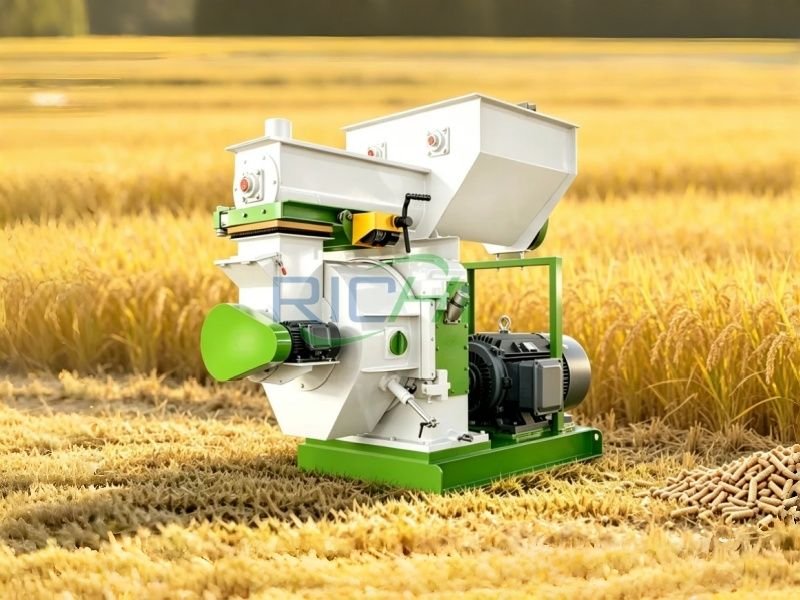
For a project handling multiple crop residues, a 0.5-8 T/H wheat straw pellet machine for sale may need to be evaluated according to the specific feedstock mix rather than simply using the maximum nominal capacity as the main selection criterion.
A machine that performs well with one residue may require different preparation settings for another.
The Role of the Die
The pellet die determines the basic diameter of the finished pellet.
But it also influences compression.
Different biomass materials require different compression conditions because their fiber structure, density, and natural binding properties vary.
A producer making heating pellets for industrial boilers may prioritize density and durability.
Another producer may have different requirements for animal bedding or agricultural applications.
Therefore, pellet specifications should be established before selecting the die configuration.
Cooling Is Essential After Pelletizing
Fresh biomass pellets can leave the pelletizing chamber hot.
They may also contain residual moisture.
Packaging the pellets immediately can cause condensation and affect storage stability.
Cooling allows the pellets to reach a more suitable temperature while helping stabilize their structure.
A cooler can therefore be an important part of a commercial pellet production system.
For larger plants, counterflow cooling systems are often integrated into the production line.
Screening Improves Product Consistency
After cooling, pellets may contain a certain amount of fines.
Screening separates qualified pellets from undersized particles.
The fines can often be recycled into production.
This improves material utilization and creates a cleaner finished product.
For commercial customers, consistent pellet size can also simplify automatic feeding, storage, and transportation.
Where Can Corn Stalk Pellets Be Used?
The final application determines many of the production requirements.
Biomass pellets may be used for:
- Industrial boilers
- Farm heating
- Greenhouse heating
- Residential biomass stoves
- District heating systems
- Poultry house heating
- Process heat
- Biomass power generation
Different users may have different requirements for pellet diameter, density, ash content, moisture, and durability.
A producer should therefore define the target market before designing the factory.
A Small Plant Can Be a Regional Business
A biomass pellet project does not always need to be an enormous industrial facility.
In agricultural regions, a small or medium-sized plant can collect residues from nearby farms and process them into a standardized fuel.
The business model may involve:
- Purchasing or collecting residues.
- Preparing and storing raw materials.
- Processing them into pellets.
- Packaging or bulk loading.
- Selling to local energy users.
Transportation distance becomes important because biomass is relatively bulky before processing.
A plant located close to the raw material source can have a logistical advantage.
Why Integrated Production Matters
A standalone pellet mill may appear cheaper at first.
However, if the raw material requires chopping, drying, conveying, and cooling, purchasing only the pellet mill does not solve the entire production challenge.
A complete system can integrate:
- Feeding
- Crushing
- Drying
- Conveying
- Pelletizing
- Cooling
- Screening
- Packaging
An integrated pellet plant can therefore provide more stable material flow and simplify operation.
Storage Can Determine the Success of the Project
Biomass is seasonal.
A factory may have abundant straw after harvest but limited supply several months later.
This makes raw material storage an important part of business planning.
Storage facilities should protect the biomass from rain and excessive humidity.
However, storage also requires management.
If material is stored with excessive moisture, microbial activity and degradation can occur.
Therefore, storage and drying should be considered together.
What Makes a Good Biomass Pellet Project?
A successful project usually combines four elements:
Reliable raw materials: The plant needs sufficient biomass throughout the operating period.
Appropriate processing: The equipment must match the actual material.
Stable product quality: Pellets need to meet the requirements of the intended market.
Reasonable logistics: The cost of collecting and transporting raw materials must be manageable.
A technologically advanced machine cannot compensate for poor raw material economics.
A More Sustainable Agricultural Economy
Turning crop residues into pellets can create additional value from existing agricultural resources.
Farmers gain another potential revenue stream.
Local businesses can develop collection and transportation services.
Manufacturers can create jobs around processing and packaging.
Energy users gain access to locally sourced biomass fuel.
Instead of treating crop residues purely as waste, agricultural communities can consider them part of a circular resource system.
For further background on biomass processing and agricultural residue utilization, helpful resources can provide additional perspectives.
Final Thoughts
Crop residues are not automatically valuable simply because they are abundant.
They become valuable when collection, processing, logistics, and market demand are properly connected.
Corn stalks, wheat straw, and rice straw each present different technical challenges, but modern pelletizing systems can convert these materials into a more compact and commercially useful product.
For businesses entering the biomass fuel market, the most important decision is not simply choosing the biggest machine.
It is designing a production process that matches the local residue supply, moisture conditions, target pellet specifications, and final customers.