A chicken manure pellet machine project begins with a material that changes substantially during storage and treatment. Fresh manure can contain high moisture, variable bedding content and foreign matter; composted manure has different flow and forming properties. The equipment should therefore be selected only after the project defines its manure source, fermentation or composting route, moisture range, nutrient objective and finished fertilizer specification. A pellet machine cannot replace biological treatment or correct an unsuitable raw-material mixture.
RICHI’s chicken manure pellet machine solution is intended for processing treated organic materials into fertilizer pellets. Depending on the feedstock and product requirements, the line may include dewatering, fermentation, crushing, batching, mixing, granulation or pelleting, drying, cooling, screening and packaging. The exact process should be designed around the condition of the manure after treatment and the required final moisture and nutrient profile.
Define the Manure Source and Treatment Stage
Chicken manure may be collected with rice husk, wood shavings, straw or other bedding. These additions change moisture, fiber content, bulk density and nutrient concentration. Record the manure source, bedding type, collection method, storage time and contamination. If the plant receives manure from several poultry houses, keep batches identifiable because their moisture and bedding ratios may differ.
Fresh manure should not be sent directly to a fertilizer pellet machine without confirming the required treatment. Fermentation or composting is used to stabilize organic material and reduce problems associated with untreated manure. The treatment method, duration and endpoint depend on the process design and local regulations. The pelletizing line should receive material that has reached the agreed condition, not compensate for incomplete treatment.
If incoming manure is very wet, mechanical dewatering may be required before fermentation or drying. Measure moisture before and after dewatering and record the amount of solids retained. A material balance helps estimate the capacity of the fermentation area, dryer and pelletizing section. Do not size the dryer from the wet truck tonnage alone.

Control Moisture Through the Treatment and Pelletizing Route
Moisture changes at several stages: collection, dewatering, fermentation, mixing, granulation and drying. Each measurement should use a consistent basis and sampling method. A batch that is too wet may adhere to equipment or form unstable granules; a batch that is too dry may create excessive fines or require a different binder or conditioning approach. The suitable operating window must be validated with the actual treated manure.
The drying calculation should use wet feed rate, inlet moisture and target outlet moisture to determine the water-removal duty. Heat source, residence time, airflow and exhaust conditions then influence dryer selection and operating cost. If manure is blended with crop residues or other organic materials, the mixture may behave differently from pure poultry manure and should be tested before the dryer is sized.
Protect dried material from moisture pickup before granulation or storage. Use covered bins, stock rotation and controlled transfer. If the plant uses a wet granulation route, the liquid addition and binder system should be specified separately. Do not assume that one moisture setting suits every recipe or pellet diameter.
Build the Formula Around the Intended Fertilizer Product
Chicken manure contains nutrients, but its composition varies with feed, bedding, collection and treatment. If the product will be sold with a declared nutrient analysis, the formula and quality-control plan should be based on laboratory testing. Additional organic materials or mineral nutrients may be blended to meet the target specification. The pellet machine only forms the mixture; it does not guarantee the nutrient content.
A batching and mixing system should meter each component in the correct proportion. Fibrous bedding, fine manure powder and mineral additives can segregate if the feeding and mixing sequence is poorly controlled. Record recipe versions, batch weights, moisture and mixing conditions. If the plant changes between formulas, define cleaning and changeover procedures to prevent product inconsistency.
The target product also affects pellet diameter, density and strength. Agricultural users may prefer a size suitable for spreading equipment, while retail bags may require a more uniform appearance and low fines. Confirm the application and customer requirements before choosing the die, granulator or pellet press.
Select the Forming Route for the Prepared Material
Organic fertilizer can be formed using different granulation or pelletizing technologies depending on moisture, particle size, binder and desired shape. A ring-die pellet machine compresses prepared material through die holes; other granulation systems may use rolling or extrusion mechanisms. The right choice depends on the material’s plasticity, throughput and finished-product specification. Do not compare machines solely by their nominal capacity if they produce different pellet shapes or require different moisture conditions.
For a dry pelletizing route, the prepared material needs a controlled particle size and moisture range. For wet granulation, liquid addition and subsequent drying may be central to the process. The equipment proposal should state which forming principle is used, what material conditions are assumed and which auxiliary machines are included.
Cooling and screening stabilize the finished product and separate fines or off-size pellets. If fines are recycled, the return point and recycle ratio should be defined. Excessive recycle can reduce net output and consume additional energy. Packaging should protect pellets from moisture and physical damage during storage and transport.
Design the Fermentation and Factory Layout as One System
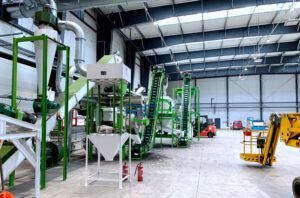
The layout should separate incoming manure, active fermentation, matured material, finished fertilizer and packaging. Provide space for turning or aeration equipment where required by the selected composting method, drainage, leachate collection, ventilation and odor management. The fermentation area can be a major part of the project footprint and should not be treated as a small accessory to the pellet line.
Material movement between treatment and pelletizing should be planned to avoid cross-contamination and unnecessary rehandling. Confirm loader routes, transfer conveyors, covered storage, dust extraction, floor loading and access for cleaning. The dryer, granulator, cooler and packer should be arranged to allow safe maintenance and removal of major components.
The utility plan should include electrical loads, heat source, water, ventilation, drainage and dust collection. Define responsibilities for civil works, transformer, distribution panels, external conveyors, exhaust systems, odor-control equipment, installation and commissioning. These interfaces should be agreed before construction begins.
Commission With Treated Manure and Laboratory Checks
A meaningful production trial should use manure that has completed the agreed treatment and represents normal commercial supply. Record bedding ratio, moisture, particle size, recipe, batch weights, forming settings, dryer conditions, cooler discharge, fines and saleable output. Collect finished-product samples for the agreed nutrient, moisture and physical-quality tests.
Acceptance criteria should distinguish the forming machine’s output from finished saleable fertilizer after drying, cooling and screening. Define test duration, sampling frequency, product specification and utility conditions. If the pellets crack or create excessive fines, investigate moisture, formulation, particle size, binder and forming settings before changing several variables at once.
Treated Manure Batch Release Checklist
Do not release a batch solely because it has completed a preset number of fermentation days. Use the validated treatment endpoint and applicable local requirements. Record manure source, bedding type, batch date, treatment method, moisture, temperature history where monitored, contamination and required laboratory results. If the batch is outside the accepted condition, hold it for further treatment or adjustment. For fertilizer sold with declared nutrient values, use representative laboratory sampling and retain traceability between the tested batch and packaged product. Moisture and pellet appearance cannot substitute for nutrient analysis.
Assign a batch identifier when manure enters treatment and retain it through dewatering, fermentation, blending, forming, drying and packaging. Record ingredient lots, moisture at key stages and laboratory results. If treated batches are blended, preserve the blend record so the finished fertilizer can be traced to its inputs. Set a hold-and-release procedure for off-spec material and identify a separate reprocessing route. Do not mix unverified material into released product merely to maintain throughput.
Organic Fertilizer Plant Risk Register
Calculate material flow at each treatment stage. Dewatering changes wet mass and solids concentration; fermentation changes moisture and organic matter; drying removes water; screening creates a fines stream. Balance receiving, composting, dryer, mixer, forming and packing capacity using the relevant stage flow. Include buffer space for batches awaiting release and a route for rejected or off-spec material. Do not apply the incoming wet manure tonnage to every machine because the mass flow changes as water is removed.
Design odor, leachate, drainage and ventilation controls with the fermentation area. Identify runoff collection, floor slope, washdown route and environmental-permit responsibilities. Separate incoming manure, active treatment, matured material and finished fertilizer storage. If the manure source or bedding ratio changes, review treatment capacity and odor-control assumptions before increasing throughput. Assign an owner and inspection frequency to each high-impact risk.
Define Product Claims and Laboratory Sampling
Clarify whether the product is marketed as a general soil amendment, an organic fertilizer with declared nutrient values or an organic-mineral blend. Chicken manure composition varies with poultry diet, bedding, collection and treatment, so do not assign a fixed nutrient value from the raw-material name. Use representative laboratory testing and have the formulation reviewed by a qualified fertilizer specialist before printing nutrient claims. Physical checks such as moisture, pellet dimensions and fines do not replace chemical analysis where nutrient values are declared.
For batch-based treatment, estimate the material occupying the fermentation area at one time using daily incoming manure, validated residence period, moisture change and the number of batches handled in parallel. Add space for turning, aeration, loader access, drainage and separation between active and matured material. If the treatment area is undersized, the pelletizing section may wait for treated feedstock even when the dryer and press have spare capacity. Release material based on process evidence and applicable local requirements, not a fixed calendar assumption alone.
Conclusion: Specify the Treated Material Before Choosing the Machine
A chicken manure pellet machine is only one part of an organic fertilizer project. Reliable production depends on manure source, bedding ratio, biological treatment, moisture control, formulation, forming route, drying and finished-product handling. The equipment should be selected after the treated material and product specification are clearly defined.
For equipment options and process scope, review the RICHI chicken manure pellet machine solution. Prepare manure samples, treatment details, moisture data, target nutrient profile, required output and site layout before finalizing the project.