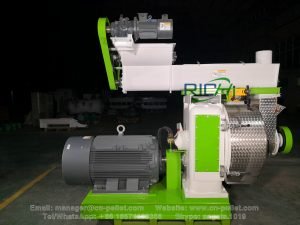
Sunflower processing generates shells and husks that can become useful biomass feedstock when sufficient quantities are available. Instead of transporting and storing this loose material, producers can process it into denser fuel pellets.
A sunflower shell pellet machine compresses prepared sunflower shell particles through a die. However, the pellet mill is only one part of the process. The condition of the shells, particle size, moisture, required capacity, and final pellet specification all influence the production setup.
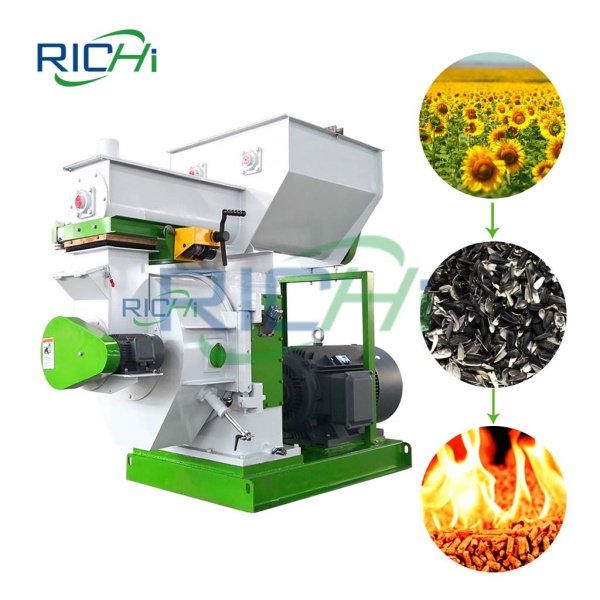
What Are Sunflower Shells Like?
Sunflower shells are generated during sunflower seed processing. Depending on the processing method, the material can contain shells, small particles, dust, and other residues.
The material should be inspected before entering the production line.
Important factors include:
- Moisture content
- Particle size
- Bulk density
- Amount of dust
- Foreign materials
- Daily available quantity
This information helps determine whether additional crushing, screening, or drying equipment is necessary.
Do Sunflower Shells Need Crushing?
It depends on their initial condition.
Some sunflower shells are already relatively small and may require only limited size reduction. Larger pieces or mixed agricultural residues may need a hammer mill before pelletizing.
The purpose of crushing is to create a consistent feedstock that can enter the compression chamber smoothly.
Producing an extremely fine powder is not necessarily beneficial. Excessive grinding can increase electricity consumption and may not provide a meaningful improvement in pellet formation.
The actual material should therefore be tested before the final equipment configuration is selected.
How Does Moisture Affect Pellet Production?
Moisture plays an important role in biomass pelletizing.
If sunflower shells contain too much moisture, the material may not compress consistently and can affect the stability of the pelletizing process.
A dryer can be installed when the feedstock requires moisture reduction.
However, pre-dried sunflower shells may not need a separate drying system.
This distinction can significantly affect both equipment investment and operating costs.
What Happens Inside the Pellet Mill?
Prepared sunflower shell particles enter the pellet mill and are compressed under pressure.
The rollers force the material through openings in the die, forming cylindrical pellets.
The die determines the approximate pellet diameter, while the cutting system controls pellet length.
The appropriate specification depends on the intended fuel application.
A producer supplying industrial customers may use a different pellet specification from a small producer using the pellets for its own heating system.
Can Other Agricultural Residues Use Similar Equipment?
Yes, many agricultural residues can be processed using similar pelletizing principles.
For example, a 5T/H rice husk pellet machine belongs to the same general category of biomass pelletizing equipment, although rice husk and sunflower shells have different physical characteristics.
Rice husk contains a relatively high mineral and ash fraction, while sunflower shells have their own material properties. These differences can influence crushing, feeding, die selection, and operating conditions.
Therefore, similar machine categories do not mean that every raw material should use identical settings.
How Should Production Capacity Be Selected?
Capacity should be based on the available sunflower shells and the planned operating schedule.
A small seed-processing facility may generate a limited amount of shells each day. A large oilseed-processing factory may produce a much larger and more continuous feedstock supply.
The pelletizing capacity should be matched to this supply.
If the pellet mill is much larger than the available raw-material flow, the equipment may operate below its practical capacity.
If it is too small, material can accumulate upstream.
A balanced production rate is usually more useful than simply selecting the largest available machine.
What Auxiliary Equipment May Be Needed?
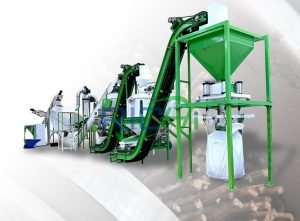
A sunflower-shell pellet process can include:
Sunflower Shells → Cleaning → Crushing if Required → Drying if Required → Pelletizing → Cooling → Screening → Packing
The exact process depends on the raw material.
A small producer may use a compact preparation system and manual packing.
A commercial plant can add conveyors, storage bins, automatic feeding, dust collection, and automatic packaging.
Why Is Cooling Important?
Pellets leave the compression chamber hot.
A cooler reduces their temperature before they enter storage or packaging. Cooling also helps the pellets become more stable for handling.
After cooling, a screener can remove fines and broken pieces.
Suitable fines can potentially return to the pelletizing process, depending on the production design.
For larger plants, cooling and screening can be integrated into a continuous conveying system.
How Should the Pellets Be Stored?
Biomass pellets should be protected from rain and excessive humidity.
Moisture can weaken pellets and make them less suitable for storage and transportation.
A dry warehouse or covered storage facility can help maintain product quality.
Storage capacity should be planned according to daily production and transportation frequency.
If the sunflower processing season is concentrated in a particular period, additional storage may also be useful for maintaining fuel availability after the harvest period.
What Should Buyers Ask a Supplier?
Before requesting a quotation, buyers should prepare information about:
- Sunflower shell type
- Moisture content
- Current particle size
- Available daily quantity
- Desired pellet diameter
- Required production capacity
- Electricity specification
- Factory space
- Packaging requirements
Photos or samples can also help determine whether the raw material requires additional preparation.
The pellet making machine should then be selected together with the crushing, drying, cooling, and conveying equipment so that the entire production process remains balanced.
Sunflower shells can be a practical biomass feedstock when the material supply is stable and the equipment is matched to its actual characteristics. A well-designed system does not necessarily require every possible auxiliary machine; instead, each stage should solve a specific production requirement. For additional information about agricultural-residue pelletizing and biomass fuel production, read more.
Related Post: https://pelletizerequipment.com/corn-stalk-pellet-machine/