A supplier that understands individual pellet machines can explain motor power, die diameter, gearbox type, and nominal capacity. A supplier that understands complete production lines must go much further. It should explain how raw materials are received, prepared, stored, dosed, conditioned, pelletized, cooled, screened, conveyed, packed, controlled, maintained, and expanded as one connected system. For a buyer planning a new pellet factory, the difference matters because most project problems occur at the interfaces between machines rather than inside one machine considered alone.
Ask The Supplier To Start With Your Raw Material
A complete-line supplier should begin by defining the material entering the factory. Moisture, particle size, bulk density, fiber structure, formulation, contamination, and seasonal variation determine which preparation stages are required. A salesperson focused only on the pellet mill may jump immediately to a model number. A process-oriented supplier first asks whether drying, crushing, screening, mixing, liquid addition, fermentation, or storage is needed before pelleting.
For fertilizer pellets, for example, the process may involve different preparation and finishing steps from feed or biomass pellets. The supplier should understand the behavior of the actual raw materials rather than assume that every pellet line is the same.
Ask For A Mass-Flow Explanation
A complete production line should be designed around material flow. Ask the supplier to explain how many tons per hour enter each stage, what losses or recycle streams occur, and what buffer capacity is provided between major machines. If the plant is rated at 10 t/h, that does not mean every machine should simply have a 10 t/h nameplate. Some stages need margin because flow fluctuates, some receive recycled material, and some operate intermittently.
An experienced process engineer should be able to identify the expected bottleneck and explain what happens when raw-material conditions change. This is much stronger evidence of complete-line understanding than a list of individual capacities copied from brochures.
Test Whether The Supplier Understands Buffering
Production lines rarely run at perfectly steady flow. Surge bins and intermediate storage can separate stages so that a short interruption does not stop the entire factory. Ask why each bin is included, how its volume was selected, and what happens if it becomes full or empty.
- What stage can continue operating if the pellet mill stops?
- How long can the downstream section continue if upstream preparation stops?
- Which bins need level sensors?
- Where can material be safely held during a changeover?
- Which sections must stop immediately when a downstream machine trips?
These questions reveal whether the supplier thinks about plant behavior over time rather than only machine performance at one moment.
Ask How The Machines Are Interlocked
Complete-line understanding includes control logic. Equipment should start and stop in a sequence that prevents material from accumulating in conveyors, elevators, coolers, or screens. A downstream trip should trigger a controlled upstream response. The supplier should explain permissives, interlocks, emergency stops, alarms, bin-level logic, and variable-speed control where required.
A supplier that says the customer can simply connect all machines after delivery may understand the equipment mechanically but not as an operating production system. For a commercial plant, control philosophy should be developed alongside the process flow.
Review The Plant Layout, Not Just The Flow Diagram
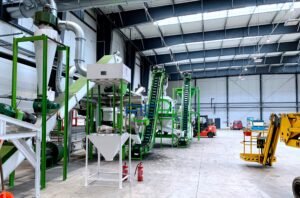
A process can be logically correct and still produce a poor factory layout. Complete-line engineering must consider building dimensions, gravity flow, conveyor length, maintenance space, stairs, platforms, hoists, operator access, dust collection, cable trays, piping, forklift movement, and future expansion. Ask the supplier to explain why each machine is placed where it is.
Look especially at maintenance tasks. Can the pellet mill ring die be removed? Can a motor or gearbox be lifted out? Can screens be changed without dismantling nearby equipment? Can operators clean under conveyors and access inspection doors safely? These questions expose layouts created only to fit machines on a drawing.
Check Whether Utility Requirements Are Integrated
Complete plants depend on electrical power, steam, compressed air, water, fuel, and sometimes thermal energy for drying. The supplier should provide total installed power, expected operating demand, major motor starting requirements, steam consumption, air demand, and other utility conditions. It should also explain where these utilities connect to the line.
If utility information appears only after the machines are manufactured, the project has not been engineered as a complete plant. Utility requirements affect transformer sizing, boiler selection, pipework, building services, operating cost, and site preparation.
Ask About Dust, Fines, And Recycle Streams
Pellet production creates fines, dust, oversize material, and product that may need to be recycled. A complete-line supplier should define where these streams go. Screening rejects should not simply be discharged without a plan. Dust collectors need correct pickup points and discharge arrangements. Recycle loops need capacity so they do not overload upstream equipment.
These small streams can become major operating problems when ignored. Their treatment is a useful test of whether the supplier has real production experience.
Evaluate Product Changeover Logic
If the factory will make several products, ask how the line changes from one product to another. The supplier should consider material segregation, cleaning, flushing, bin assignments, recipe control, die changes, screen changes, packaging labels, and the handling of transitional product. This is especially important when cross-contamination or product identity matters.
A machine-focused supplier may say that the pellet mill can produce multiple products. A line-focused supplier explains what the entire factory must do to change products efficiently.
Ask For Operating Scenarios
One of the best tests is to describe realistic operating events and ask the supplier what the plant does. What happens when the packaging machine stops? What happens when a storage bin is full? What happens when the pellet mill motor reaches high load? What happens when the raw-material moisture increases? What happens when an elevator trips?
An experienced complete-line engineer should trace the effect through upstream and downstream equipment. The answer does not need to be immediate, but it should be technically coherent and reflected in the control philosophy.
Look For Cross-Discipline Engineering
Complete lines require process, mechanical, structural, electrical, automation, civil, and utility interfaces. Ask how these disciplines coordinate drawings and revisions. Moving one machine can affect foundations, platforms, cables, ducts, pipework, access, and control logic. The supplier should have a method for updating all affected documents.
A project becomes risky when different departments work from inconsistent equipment numbers or elevations. Strong complete-line suppliers use coordinated project documents rather than independent machine drawings.
Ask For Complete Project References
References should match the type and scale of project being proposed. Ask for complete lines with similar raw materials, capacity, automation level, and finished products. Review plant photographs, process diagrams, layouts, commissioning information, and operating feedback where available.
A supplier may have manufactured hundreds of pellet mills without having delivered many integrated factories. Those are different capabilities. Complete-line references show whether the company has managed the interfaces that appear only at project scale.
Check The Documentation Package
A complete-line supplier should be able to provide more than individual machine manuals. Depending on scope, documents may include process diagrams, equipment lists, layouts, foundation drawings, structural loads, electrical load lists, cable schedules, pneumatic diagrams, utility requirements, control descriptions, installation drawings, and final as-built documentation.
The quality of these documents is a direct indicator of whether the supplier has engineered the plant as one system.
Use A Complete-Line Capability Scorecard
| Area | Complete-Line Evidence | Machine-Only Warning Sign |
|---|---|---|
| Raw material | Preparation route defined | Pellet mill selected immediately |
| Capacity | Mass flow and bottlenecks explained | Every machine given same capacity |
| Controls | Interlocks and sequences defined | Machines treated independently |
| Layout | Maintenance and utilities considered | Equipment only arranged to fit |
| Changeover | Whole-line procedure explained | Only die change discussed |
| Documentation | Integrated project drawings | Only machine manuals supplied |
How RICHI Machinery Fits This Evaluation
RICHI Machinery works across complete feed, biomass, fertilizer, and other pellet production projects rather than only stand-alone pellet mills. Buyers can review its broader turnkey scope through pellet machine solutions. More than 30 years of industry experience and over 2,000 delivered projects provide a useful project base, but any new buyer should still verify that the proposed line matches the current raw material, site, and product requirements.
The strongest evaluation is project-specific: ask the engineering team to explain your material flow, bottlenecks, utilities, layout, control sequence, and changeover strategy in one connected review.
Verify Interfaces Before Accepting A Complete-Line Claim
A supplier should be able to explain the operating interface between each major stage, not merely place machines on an equipment list. Ask how upstream variation changes the load on downstream equipment, how buffers are sized, where sampling takes place, and which control signals prevent one stoppage from damaging the rest of the line. The proposal should identify expected bottlenecks under normal and adverse raw-material conditions.
During technical review, select one realistic disturbance—such as higher moisture, lower bulk density, a packaging interruption, or a screen change—and ask the supplier to trace the operational response through the entire process. A team with genuine complete-line experience can describe capacity consequences, control actions, cleanout requirements, and recovery steps. A machine-only seller usually returns to individual nameplate capacities without explaining system behavior.
Final Recommendation
You can tell whether a supplier understands complete pellet production lines by asking questions that cross machine boundaries. Focus on material flow, buffering, interlocks, utilities, layout, dust and recycle streams, product changeover, site interfaces, documentation, and operating scenarios. A supplier that consistently answers at system level is demonstrating more than knowledge of individual machines.
For a new pellet factory, that system knowledge is essential. The pellet mill may be the central machine, but plant performance depends on every stage around it. Choose a supplier that can explain how the entire factory behaves under normal production, changes, and faults—not only how one machine performs on a specification sheet.